How Long Does a Sinus Infection Last? When to Worry
Most sinus infections clear up on their own in 7 to 10 days. Get the full timeline, warning signs of a bacterial infection, and when to call a doctor.

The short version
- Most episodes of acute sinusitis are self-limited and last 7 to 10 days.
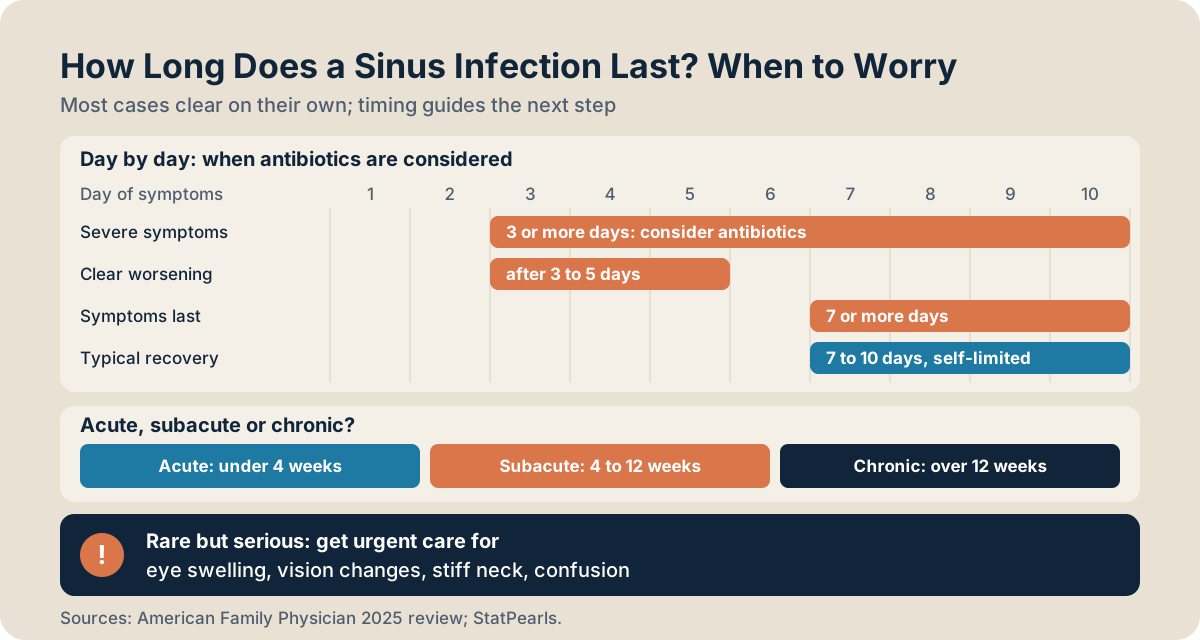
- Antibiotics are considered for 3 or more days of severe symptoms, clear worsening after 3 to 5 days, or 7 or more days of symptoms.
- Acute sinusitis lasts under 4 weeks, subacute lasts 4 to 12 weeks, and chronic lasts more than 12 weeks.
- Serious complications are rare, but eye swelling, vision changes, a stiff neck or confusion need urgent care.
Most sinus infections get better on their own within about 7 to 10 days. Some last longer, and a few need medical care. This guide explains the normal timeline, the signs that point to a bacterial infection, and the red flags that mean it is time to call a doctor.
How long does a sinus infection last?
Most episodes of acute sinusitis are self-limited and last 7 to 10 days, according to a 2025 rapid evidence review in American Family Physician. Acute sinusitis can last up to 4 weeks, but a typical cold-triggered case is much shorter.
Doctors use the length of symptoms to sort sinus problems into groups. These labels come from a StatPearls clinical reference.
| Type | How long symptoms last |
|---|---|
| Acute | Fewer than 4 weeks |
| Subacute | 4 to 12 weeks |
| Chronic | More than 12 weeks |
| Recurrent acute | 4 or more episodes a year, each lasting at least 10 days, with symptoms clearing in between |
The number of days matters. A stuffy nose on day 3 is very different from the same stuffy nose on day 30.
Why do most sinus infections go away without antibiotics?
Most start as a virus. A 2020 review in Current Allergy and Asthma Reports describes acute sinusitis as mainly an inflammatory disease triggered by a viral infection, with few cases developing into a bacterial infection. In most cases it resolves on its own, and treatment is aimed at symptoms.
The same review reports that complications are uncommon and do not depend on whether antibiotics were used. It also notes that antibiotics should be limited to cases where a bacterial infection is clearly suspected.
This matters because sinusitis is common. The American Family Physician review says acute sinusitis sends more than 30 million people in the United States to seek care each year. It also says respiratory infections, including bronchitis and sinusitis, account for 75% of outpatient antibiotic prescriptions in primary care. Antibiotics do nothing against a virus.
How can you tell a viral sinus infection from a bacterial one?
It is hard, even for doctors. Both types cause congestion, pressure and discolored mucus. The 2020 review says the two have similar symptoms, though a combination of specific signs can tell them apart.
The American Family Physician review lists the classic features of acute bacterial sinusitis:
- Facial pain or pressure on one side
- Fever above 102°F (39°C)
- Thick, pus-like nasal discharge together with a blocked nose
The same review says no simple test settles it. Sampling the sinus with a needle is too invasive to be practical. A blood test for C-reactive protein (a marker of inflammation) may help, but it is not widely available. So the diagnosis usually rests on symptoms and timing.
Color alone is not a reliable clue. Yellow or green mucus appears in many ordinary colds.
When do doctors consider antibiotics?
The American Family Physician review says antibiotics should be considered in three situations:
- Severe symptoms for 3 or more days
- Significant worsening after 3 to 5 days of symptoms
- Symptoms lasting 7 or more days
The word is "considered," not "required." The doctor weighs how sick you are, your health history and any allergies. The review notes that amoxicillin worked as well as amoxicillin-clavulanate as a first choice for people without a penicillin-type allergy. For people with that allergy, other antibiotics are options.
Only a clinician can decide this. Leftover pills from an old prescription are not a safe plan.
What helps while waiting it out?
Supportive care is the main plan for most people. The American Family Physician review says saline irrigation, nasal steroid sprays, antihistamines and decongestants may help reduce symptom severity. The review does not rank them or promise a faster recovery.
Practical steps that fit this guidance:
- Rinse with saline, using distilled, boiled-and-cooled or sterile water. The FDA warns against tap water in nasal rinse devices. For more on rinsing, see what the studies show about nasal irrigation.
- Drink fluids and rest.
- Use pain relievers as directed on the label for facial pressure and headache.
- Ask a pharmacist before using decongestant sprays, since long use can backfire.
Rinses, sprays and air conditioning can leave the inside of the nose dry and sore. Along the Jersey Shore, summer air conditioning and dry winter heating both do this. Some people add a nasal moisturizer such as Narisure, which soothes and moisturizes dry nasal passages. It is for comfort only and does not shorten an infection.
Do sinus infections last longer in children?
Not necessarily. A 2025 review in Paediatric Respiratory Reviews says acute sinusitis in children usually follows a viral cold. The viral form is self-limiting, so it clears without antibiotics.
The review also says it is important to separate a simple cold, a post-viral sinus infection and a true bacterial infection. That is because bacterial sinusitis in children can lead to severe complications involving the eye area or the brain. It says saline rinses, corticosteroids and pain relievers may provide symptom relief, and that antibiotics improved symptom scores in bacterial cases.
If a child seems very sick, has swelling around an eye, or a cold that is getting worse after a few days, call a pediatrician rather than waiting.
What if it keeps coming back or will not go away?
There are two patterns to watch.
Symptoms past 12 weeks. This is the cutoff for chronic sinusitis, per the StatPearls reference. Two or more of these signs are typical: blocked nose, discolored drainage, facial pressure, or a reduced sense of smell.
Four or more infections in a year. The StatPearls reference calls this recurrent acute sinusitis when each episode lasts at least 10 days and symptoms clear in between.
The American Family Physician review says a CT scan and a visit to an ear, nose and throat specialist (otolaryngologist) should be considered for repeated sinus infections or any concern about complications. Allergies, a crooked septum or polyps can all play a part, and a specialist can look for them.
These sources are reviews and clinical references. They summarize earlier research. They do not report new trials, and individual recovery can differ.
When should you see a doctor about a sinus infection?
Book an appointment if:
- Symptoms last 7 or more days with no improvement
- You felt better, then got clearly worse after 3 to 5 days
- Symptoms are severe for 3 or more days, including a fever above 102°F (39°C)
- Pain or pressure is strong and mostly on one side of the face
- You have had four or more sinus infections in a year
- Symptoms have lasted more than 12 weeks
Get urgent care, or call 911, if you have:
- Swelling, redness or pain around an eye
- Double vision or any change in vision
- A severe headache with a stiff neck
- Confusion, unusual sleepiness or a seizure
- A swollen, puffy forehead
These can signal a rare complication. The American Family Physician review lists orbital cellulitis (infection around the eye), meningitis and abscess. They are uncommon, but they need fast treatment.
If repeated or lingering sinus trouble is wearing you down, you can find sinus specialists at the Jersey Shore who can work out why it keeps happening.
Common questions
How many days is too long for a sinus infection?
Most acute sinus infections improve within 7 to 10 days. Symptoms lasting 7 or more days with no improvement are a reason to call a doctor, since antibiotics may be considered. Symptoms past 12 weeks are chronic sinusitis, and a specialist visit is a good idea.
Can a sinus infection go away on its own?
Yes. Most episodes are self-limited, usually lasting 7 to 10 days. Many are caused by viruses, which antibiotics do not help. Rest, fluids, saline rinses and other supportive care can ease symptoms. See a doctor if symptoms last 7 or more days or get worse after 3 to 5 days.
How do I know if my sinus infection is bacterial?
No simple test exists, so doctors go by symptoms and timing. Signs that point to bacteria include one-sided facial pain, fever above 102°F, thick discharge with a blocked nose, severe symptoms for 3 or more days, or a clear worsening after 3 to 5 days. Mucus color alone is not reliable.
What are the warning signs of a serious sinus infection?
Swelling or redness around an eye, double vision or other vision changes, a severe headache with a stiff neck, confusion, or a swollen forehead need urgent care. These can signal rare complications such as orbital cellulitis, meningitis or an abscess. Do not wait to see if they pass.
Sources
- Acute Rhinosinusitis: Rapid Evidence Review. American family physician, 2025
- Common Cold and Acute Rhinosinusitis: Up-to-Date Management in 2020. Current allergy and asthma reports, 2020
- Management of acute rhinosinusitis in children. Paediatric respiratory reviews, 2025
- Recurrent Acute Rhinosinusitis
Trusted resources
From our sister sites
Healthy NosesKids' Winter Nosebleeds: Causes and What Parents Can DoMost winter nosebleeds in kids come from dry air, colds and nose picking. Learn what causes them, how to stop one, and when to call a doctor.NJ Sinus & AllergyRagweed Season in New Jersey: Peak Dates and How to CopeRagweed season in New Jersey usually starts in mid-August and peaks in September. Learn what helps, food reactions, testing, and when to see a doctor.Articles are for general information, not medical advice. See a doctor for symptoms that are severe, last more than 10 days, or keep coming back. Last updated November 4, 2026.